
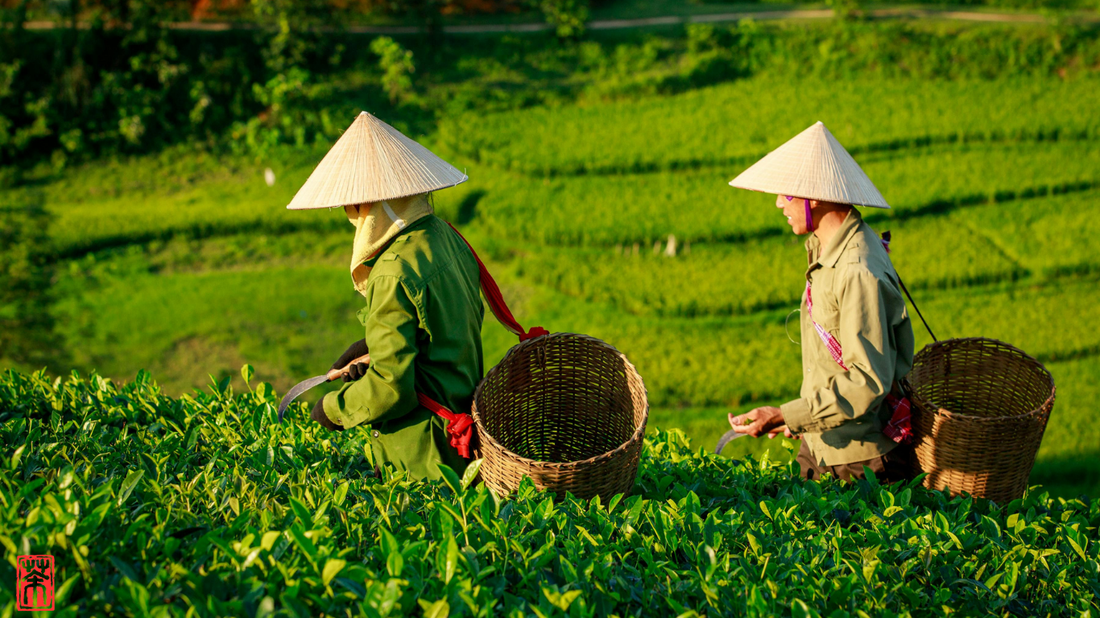
The regions of Pu-erh tea – origin and character of Yunnan teas
Split
Pu-erh tea is more than just a beverage – it's a piece of living Chinese culture. Each region of Yunnan brings its own unique character – from the sweet smoothness of Yiwu to the robust depth of Menghai. Learn here what distinguishes the main growing regions.
1. Xishuangbanna – The Heart of Pu-Erh
Location: Southernmost Yunnan, on the border with Laos and Myanmar
Altitude: 900–1800 m
Climate: Tropical and humid, with old tea forests and dense vegetation
Xishuangbanna is considered the birthplace of Pu-erh tea. Many of the world's oldest tea trees—known as Gushu (古树), some over 500 years old—grow here. The region is famous for its "Six Famous Tea Mountains" (六大茶山).
- Yiwu 易武: mild, sweet, round and harmonious
- Menghai (勐海): strong, earthy and full-bodied
- Bulang (布朗山): tart, intense, with deep bitterness
- Nannuo 南糯山: balanced, soft and fruity
- Jingmai 景迈山: floral, clear and elegant
Known teas: Dayi 7542 (Sheng), Dayi 7572 (Shu), Yiwu Gushu, Lao Man'e, Jingmai Shan Gushu
2. Lincang – The home of the ancient trees
Location: Western Yunnan, on the border with Myanmar
Altitude: 1500–2000 m
Climate: Subtropical, with clear, cool nights
Lincang is the region of ancient tree tea cultivation. Here, enormous tea trees grow, nurtured for generations. Bingdao (冰岛) is particularly well-known – one of China's finest teas, famous for its sweet elegance and cooling aftertaste.
- Mengku (勐库): fruity, clear, slightly tart
- Yongde (永德): mineral, fresh
- Fengqing 凤庆: warm, honey-like
Well-known teas: Bingdao Gushu, Mengku Mu Shu Cha, Daxueshan Sheng, Fengqing Gushu
3. Pu'er (Simao) – The historical center
Location: Central Yunnan
Meaning: Namesake of Pu-erh tea
The city of Pu'er – formerly Simao – was once the center of the tea trade. From here, the historic "Tea Horse Road" led to Tibet and Sichuan. Today, many classic aged teas originate from this region, especially Shu Pu-erh , which are characterized by rounded, earthy, and balanced aromas.
Well-known teas: CNNP 8582 (Sheng), Dayi 7262 (Shu), modern blends of Simao-Gushu
4. Baoshan – The Highlands of Contrasts
Location: Northwestern Yunnan
Altitude: 1800–2400 m
Climate: Dry, cool, sunny
Baoshan is a relatively unknown but growing tea-growing region. The teas grow at high, sunny altitudes, which gives them a fresh, slightly smoky character. Many producers here rely on wild-growing trees ( ye sheng cha ).
Well-known teas: Baoshan Wild Arbor, Gaoligong Shan Sheng
5. Dehong – Wild, spicy, authentic
Location: Border region with Myanmar
Altitude: 1000–1600 m
Dehong is known for its semi-wild tea trees and natural processing methods. The teas have a spicy, slightly bitter, and pure flavor, with a hint of smoke or wood. The Dehong Da Ye Zhong variety is frequently cultivated here – a large-leaf type ideal for Sheng Pu-erh.
Well-known teas: Dehong Da Ye Zhong, Wild Tree Sheng from Mangshi or Ruili
Conclusion – Each region, a character
Pu-erh is not a single tea, but a mosaic of regions, traditions, and flavors. Understanding its origins reveals its diversity: from the gentle sweetness of a Yiwu to the rugged depth of a Bulang – every landscape is reflected in the cup.